
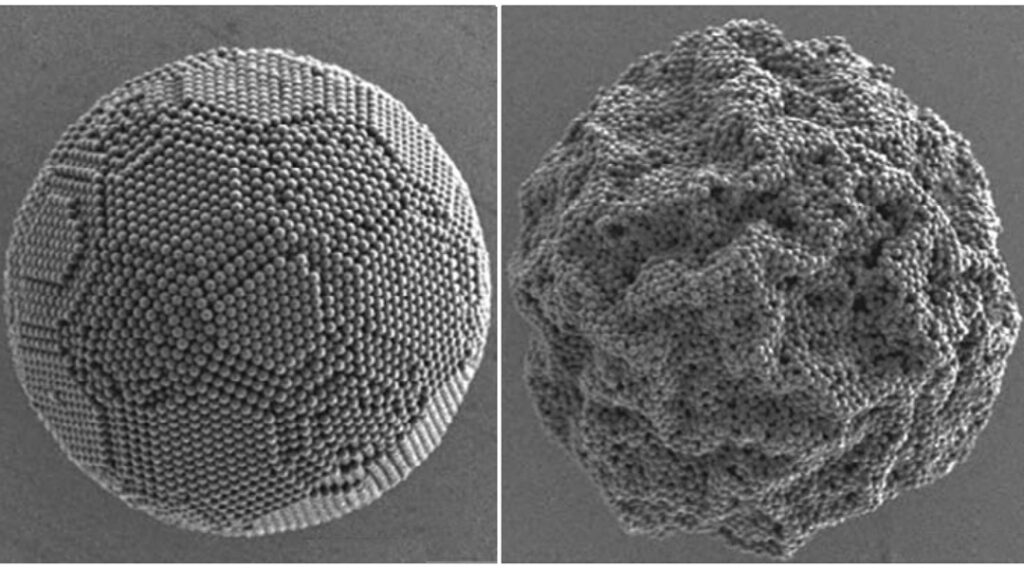
A CRC1411 recent study was featured in Advanced Science News, highlighting how we are advancing this vision by uncovering a new way to control the formation of supraparticles.
From particles to functional structures
In CRC 1411, we study particulate systems across all length scales—from individual nanoparticles to hierarchically organized assemblies such as supraparticles. These structures are particularly important because their internal arrangement determines key properties, for example optical behavior or chemical reactivity.
Supraparticles often form when droplets containing nanoparticles dry. As the solvent evaporates, particles are forced together and self-organize into a final structure. Controlling this process is crucial—but has so far remained challenging.
A new design parameter: surfactants
In our recent work, we show that surfactants can act as a powerful control knob in this assembly process.
By tuning interactions between particles and pH-responsive surfactants, we can direct where particles accumulate during droplet drying:
- If particles remain evenly dispersed, compact and homogeneous supraparticles form
- If particles migrate to the interface, thin shells emerge that can buckle into more complex shapes
This means that surfactants allow us to actively steer structure formation, rather than relying solely on drying conditions.
Dynamic control through chemistry
A key insight of our study is that these interactions can be adjusted over time using pH. As the droplet evolves, we can effectively choose when particles move to the interface—providing unprecedented control over the final architecture.
Towards true particle-by-design
Our findings contribute to a central ambition of CRC 1411: designing particulate products with targeted properties by understanding and controlling the underlying mechanisms.
By introducing surfactants as a versatile design parameter, we expand the toolbox for engineering complex particle assemblies—bringing us one step closer to creating materials with precisely tuned functionality for applications ranging from photonics to catalysis.