
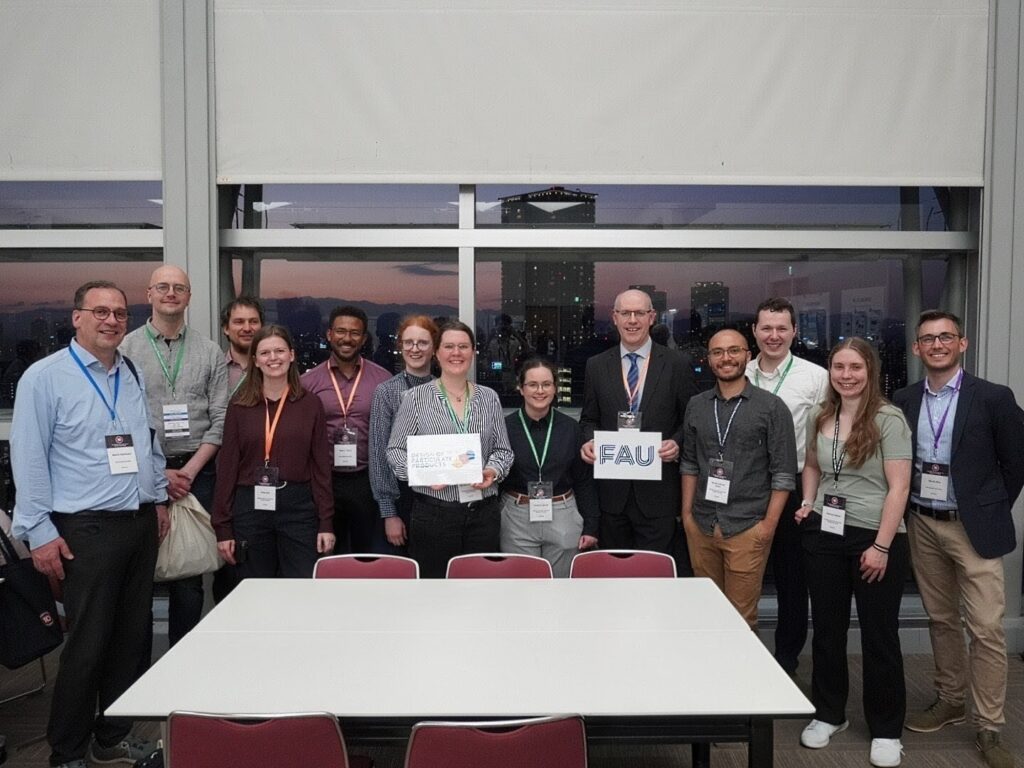
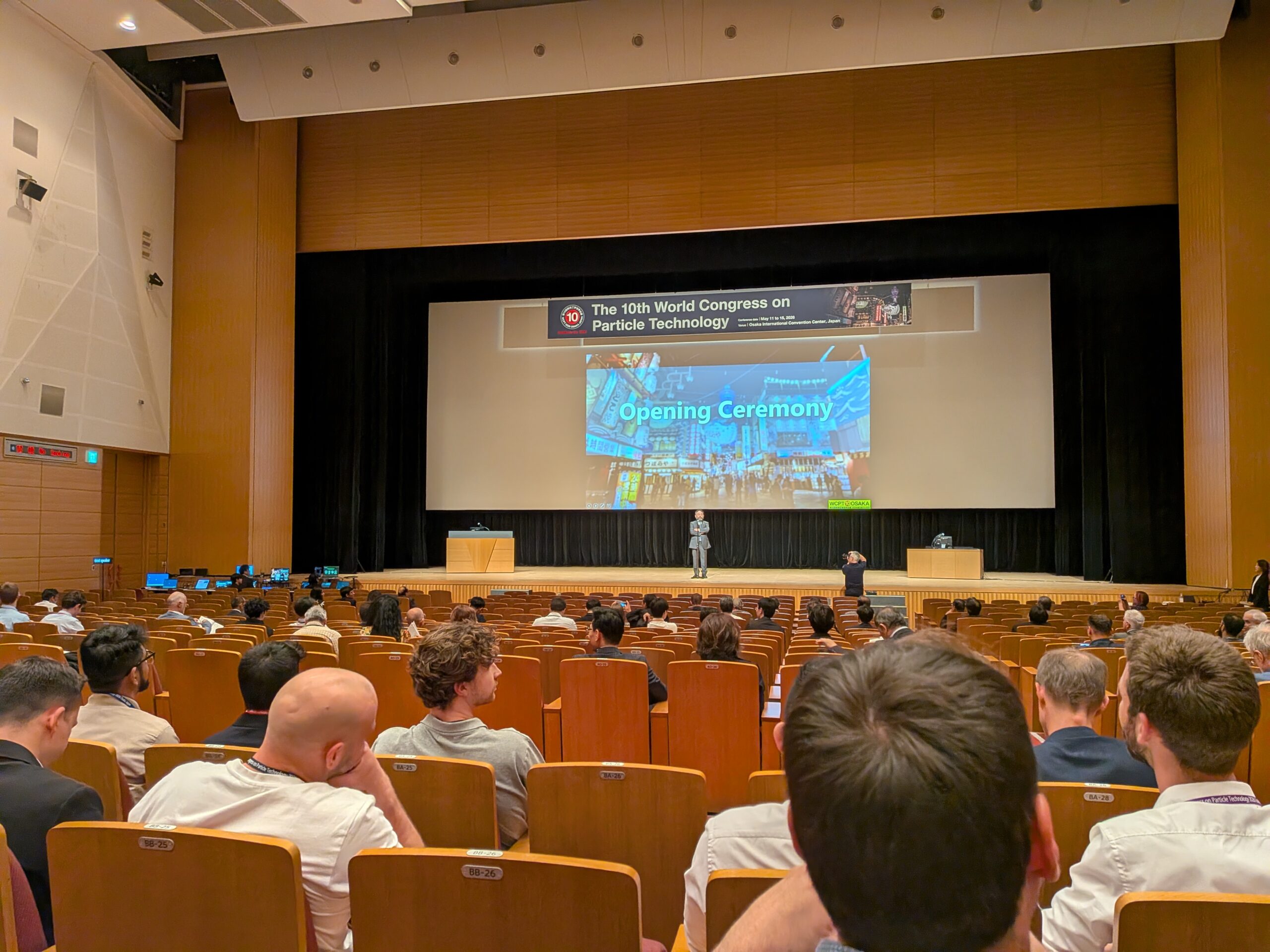
CRC 1411 “Design of Particulate Products” had a major presence at the 10th World Congress on Particle Technology (WCPT10), held from 11–15 May 2026 in Osaka, Japan. With 29 keynote, invited and oral presentations by CRC 1411 researchers, PIs and collaborators, the consortium contributed across a broad spectrum of particle technology, from nanoparticle synthesis and supraparticle formation, separation and surface design to advanced characterization and modelling.
 1/4
1/4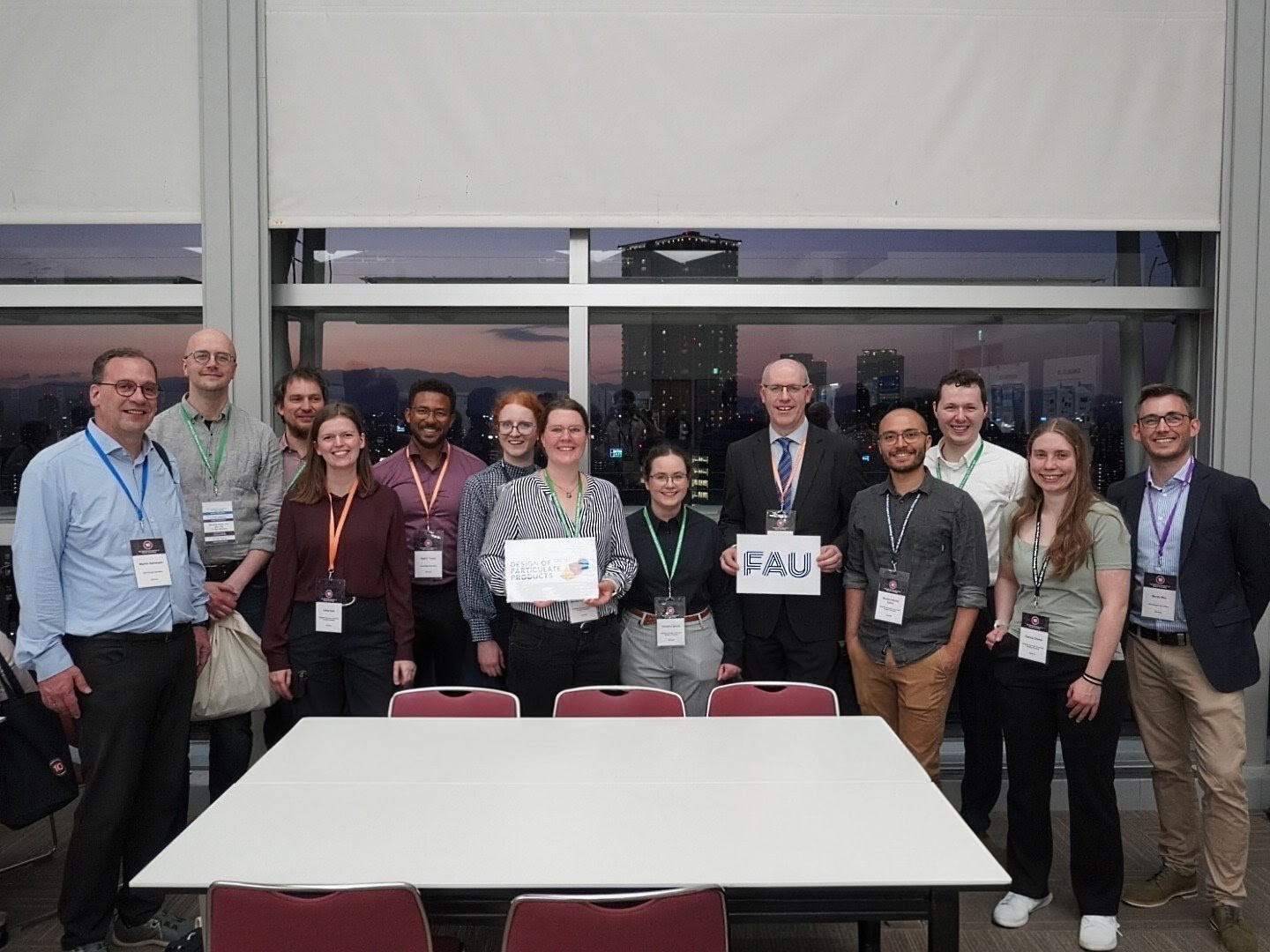 2/4
2/4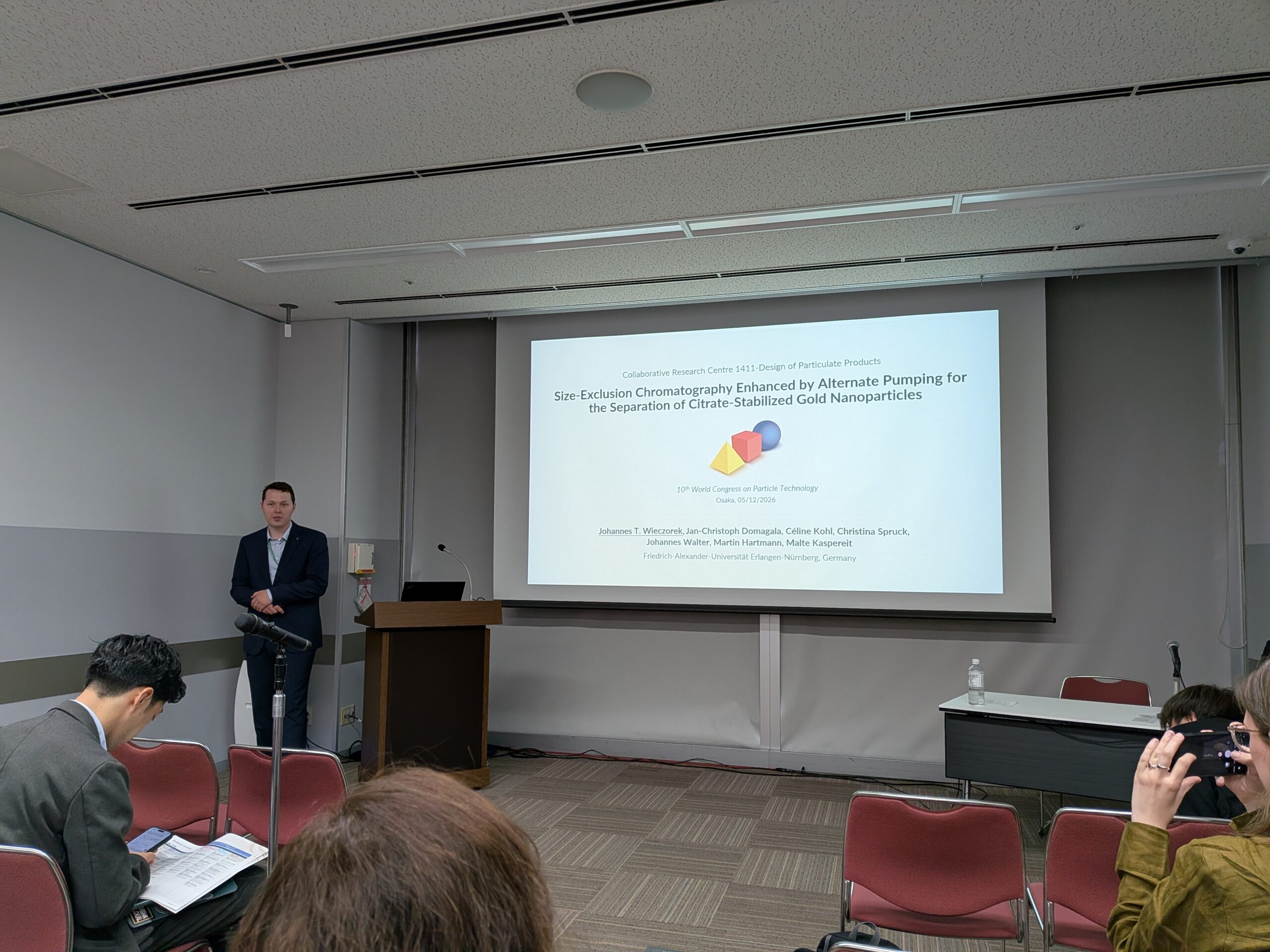 3/4
3/4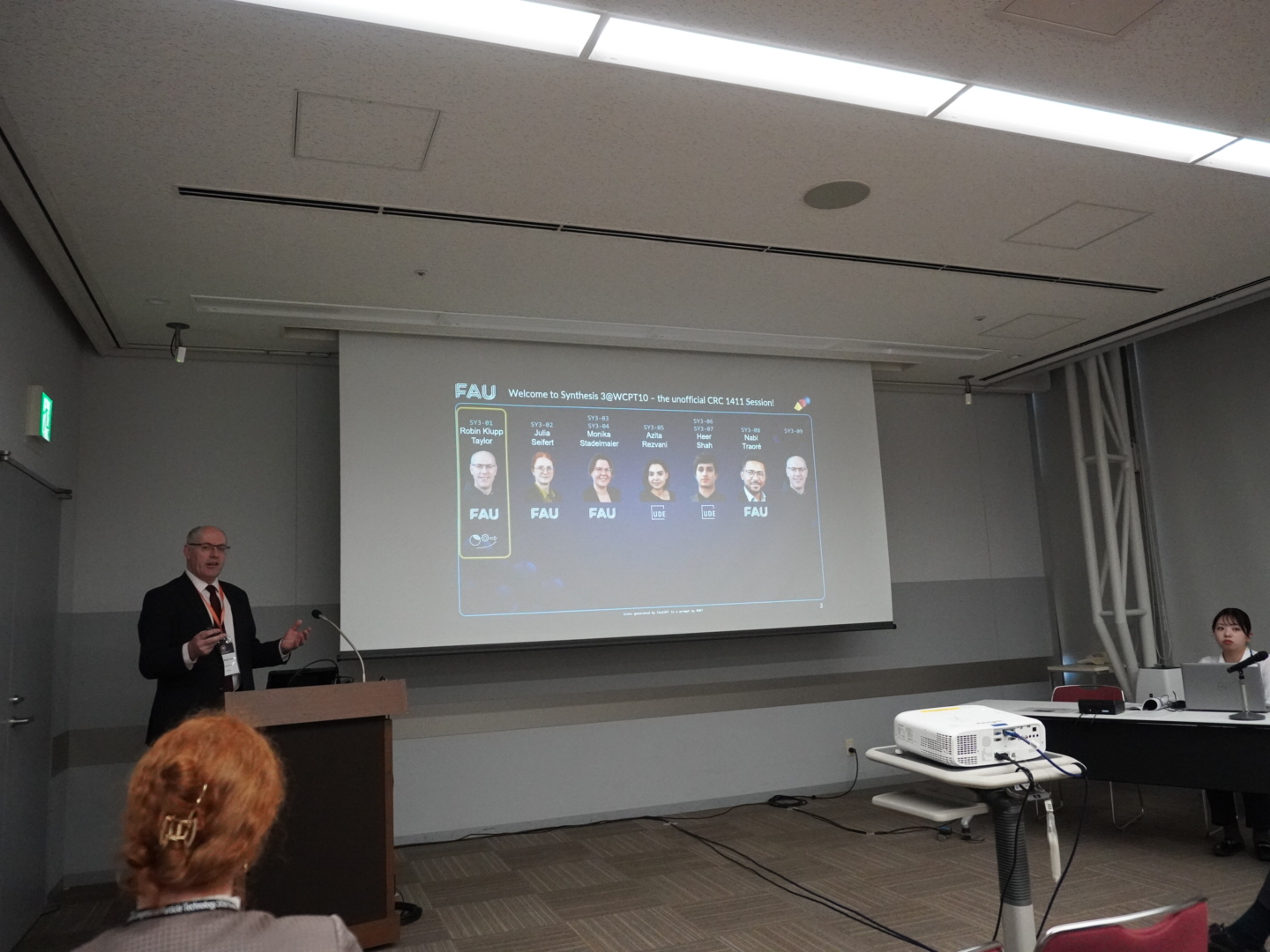 4/4
4/4A particular highlight was the Japan–Germany special session “Design of Particulate Products”, jointly organized by CRC 1411 together with Mercator Fellow Prof. Satoshi Watanabe (Kyoto University) and Japanese colleagues. The session showcased the close scientific links between the German and Japanese particle technology communities. CRC 1411 co-coordinator Prof. Martin Hartmann opened the session with a keynote on the synthesis, characterization and chromatographic separation of nanoparticles. Further CRC-related contributions came from Prof. Doris Segets, Dr. Nabi E. Traoré, who presented an invited Rising Star lecture, and Dr. Lukas Pflug.
CRC 1411 was also closely involved in the special session “Particle Technology in MOF Science and Engineering”, co-organized by CRC Mercator Fellow Satoshi Watanabe. In the session Prof. Martin Hartmann contributed an invited lecture on ultrasonic monitoring of zeolite and MOF syntheses, illustrating the consortium’s activities in the targeted synthesis and characterization of porous particle systems.
Another focal point was a synthesis session dedicated to projects from CRC 1411 Research Area A. The session opened with a keynote by PI Prof. Robin Klupp Taylor on patchy particles as engineered products and brought together work on gold and silver patchy particles, continuous-flow nanoparticle synthesis, semiconductor quantum dots and anisotropic bimetallic nanoparticles. Contributions from the Erlangen teams were complemented by CRC 1411 colleagues Azita Rezvani and Heer Shah from the University of Duisburg-Essen, emphasizing the close collaboration across the consortium.
Beyond its scientific programme, CRC 1411 also brought its education and outreach activities to WCPT10. Dr. Nabi E. Traoré presented a concept for teaching inverse design of nanoparticulate products to young audiences, while Julia S. Seifert addressed the communication gap between researchers and non-specialists with a beginner’s guide to science communication. These presentations highlighted an important part of the CRC mission: communicating particle science and the concept of inverse product design beyond the specialist research community.
A further reason to celebrate came at the end of the congress: Johannes Wieczorek received the Best Oral Presentation Award for his talk on size-exclusion chromatography enhanced by alternate pumping for the separation of citrate-stabilized gold nanoparticles. The award recognizes both the quality of his presentation and the CRC 1411 research behind the development of advanced separation strategies for nanoparticle systems.
CRC 1411 congratulates all presenters for their contributions and thanks the organizers of WCPT10 for an outstanding international forum for particle science and technology.
WCPT 10 Contributions by CRC 1411 Researchers
Particle synthesis, surface design and particulate products
- Prof. Robin Klupp Taylor — Patchy Particles as Engineered Products: Synthesis, Control and Scale-Up — Keynote
- Julia S. Seifert — Engineering gold patchy nanoparticles: Formation mechanism and morphology control
- Monika Stadelmaier — Design of Stable Silver Patch Morphology and Optical Response via Seed-directed Flow Synthesis of Patchy Particles
- Monika Stadelmaier — Automated gram-scale synthesis of plasmonic patchy particles via implementation of closed-loop feedback control
- Dr. Nabi E. Traoré — Synthesis and multidimensional characterization of anisotropic bimetallic nanoparticles
- Prof. Robin Klupp Taylor — Inverse Colour Landscapes to Wet-Chemical Synthesis: Tunable Iron Oxide Particles for High-Chroma Yellow and Red Pigments
- Patricia Schmul — Tuning the surface chemistry of noble metal nanoparticles
- Patricia Schmul — Surface design of noble metal nanoparticles: Towards controlled gold nanocluster formation
- Azita Rezvani — Efficient gold nanoparticle synthesis in continuous flow using a novel state-of-the-art dynamic mixer
- Heer Shah — Reconfigurable flow reactor platform for the colloidal synthesis of InP/ZnSe/ZnS and population balance modelling for InP quantum dots
- Heer Shah — Detection and investigation of ZnS impurities during the colloidal flow synthesis of InP/ZnS quantum dots with a single-source Zn, S precursor
- Prof. Doris Segets — Rational Ligand Design and Colloidal Stability of Platinum Nanoparticles for Cancer Proton Therapy — Invited
- Prof. Wolfgang Peukert — Shape control of particles by top-down approaches – Formation of 2D materials and platelets — Keynote
MOFs, zeolites and porous particles
- Prof. Martin Hartmann — Ultrasonic Monitoring of Zeolite and MOF Syntheses — Invited
- Nicolás Salcedo Gálvez — Silica Particles with Hierarchical Porosity
Separation, purification and formulation
- Prof. Wolfgang Peukert — Nanoparticle chromatography for purification, fractionation and characterization of nanoparticle dispersions
- Johannes Wieczorek — Size-Exclusion Chromatography Enhanced by Alternate Pumping for the Separation of Citrate-Stabilized Gold Nanoparticles — Best Oral Presentation Award
- Céline Kohl — Interaction-based separation of PEGylated gold clusters and nanoparticles on C18 columns
- Azita Rezvani — Selective agglomeration as a diagnostic tool for flow synthesis of QDs: mapping dispersity for process control and chromatographic process design
- Prof. Doris Segets — Analytical-centrifugation-informed dispersion formulation and thin film fabrication of gas-phase synthesized graphene
Particle characterization and analytical methods
- Prof. Martin Hartmann — Synthesis, Characterization and Chromatographic Separation of Nanoparticles — Keynote
- Christina Spruck — Characterization of nanoparticles – Global analysis of sedimentation data from multiwavelength analytical ultracentrifugation and analytical centrifugation
- Christina Spruck — Insights into functional particle systems and their processing via multi-dimensional characterization using analytical ultracentrifugation
Particle processing, agglomeration and supraparticles
- Prof. Andreas Bück — Real-time morphological assessment of agglomerates produced by spray fluidized bed agglomeration
- Prof. Andreas Bück — Supraparticle formation via superheated steam single droplet drying
Modelling and inverse design
- Dr. Nabi E. Traoré — Model guided design of nanoparticulate products — Invited / Rising Star
- Dr. Lukas Pflug — Exact Method of Moments: Efficient Population Balance Modeling for Targeted Nanoparticle Size Distributions — Invited
Education, outreach and science communication
- Dr. Nabi E. Traoré — Designing color: A concept for teaching inverse design of nanoparticulate products to young audiences
- Julia S. Seifert — Addressing the communication gap: A beginner’s guide to science communication