
Deutsche Version: Diese Seite auf Deutsch
Here you will find our current and recurring activities and events!
Schillernd Schön (“Iridescent Beauty”)
Together with the Bionicum in Nuremberg we have developed an exhibition on structural colour in animals (in German). Visit it and find out more about how nature creates its wonderful colours! Admission is free with a zoo ticket.
FLOWER-POWER! Insects in a flower frenzy (“Insekten im Blütenrausch”)
Why do some beetles still shine so splendidly after so many millions of years? What stories can flower pollen tell us, and what does a nose hair have to do with it? The anniversary exhibition takes you into the fascinating world of insects and plants and sheds light on their relationship – a liaison that has existed for at least 350 million years. These two groups of fossils from Messel, which are otherwise easily overlooked because of their size, help to uncover the secrets of this unique Eocene fossil site. Researchers can extract flower pollen from the stomachs of insects and compare it with pollen from flowers, which tells them which flowers the insects fed on. But even without stomach contents it is possible to find out who satisfied their hunger where: feeding traces on leaves give the little rascals away. (Exhibition in German.)
Girls’ Day and Girls and Technology: Nature as inspiration for new materials
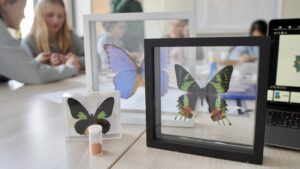
Butterflies, peacock feathers and beetles have iridescent colours. We explain how these structural colours work and how we can produce them using particles. How can such colours be created and processed to design new materials?
In short talks and experiments we take inspiration from nature, explore how we can imitate lasting colours and what other properties our systems might have.
This event took place on 23 April 2026.
KinderUni: Engineering, chemistry, mathematics and the colourful world of silver
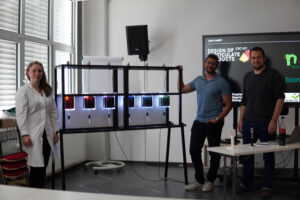
In this presentation our scientists explain how, by working together, they can make informed decisions in the production of nanoparticles. Together they can uncover the secrets behind nanoparticle colours and develop the perfect colour right before your eyes!
This event took place in July 2026.
Look out for our photo booths
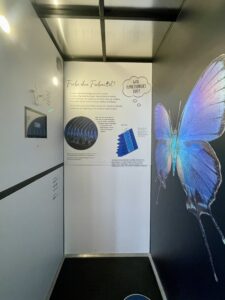
Would you like to learn more about colours and share great selfies with your friends and family to show them what you are up to? You can find our first “Selfies & Colours” photo booth in the Naturkundehaus at Tiergarten Nürnberg. Tag us in your pictures with the hashtag #FAUfarben.
More photo booths coming soon!
Past highlights
Türen auf mit der Maus 2024 – “Zusammen Tun”
On 3 October 2024 we met the Maus fans at the panOPTICUM. Max Gmelch (physicist) explained to the visitors how colours actually work. To do this, he showed pigments, mixed colours in the paint box and with light, and explained how the sun destroys the bonds in the colour molecules, so that in the end everything fades. To illustrate this, he showed the children faded toys and a once red T-shirt.
Nicolas Vogel (chemist) then showed the visitors a butterfly, peacock feathers and beetles in shimmering colours. He explained how these structural colours work and that they never fade. He and a few colleagues wanted to recreate this colour, but it was far too complicated: such difficult research with nanoparticles requires a whole team of mathematicians, chemists, physicists, materials scientists, engineers and more. That is why they teamed up with all these experts, and now it works! To prove it, he showed the children how they can recreate structural colour as a team – even on chocolate. All children were allowed to take a piece of chocolate covered with a thin layer of shimmering colours: edible structural colours. Afterwards there was still enough time to visit the Science Center, where the children could experiment themselves.
Lange Nacht der Wissenschaften (Long Night of Science)
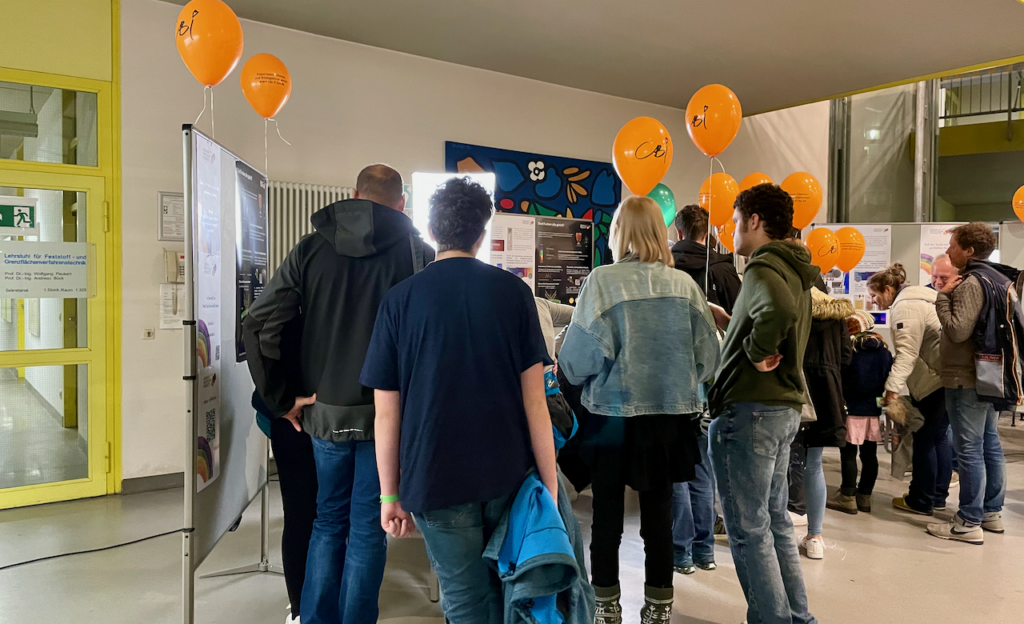
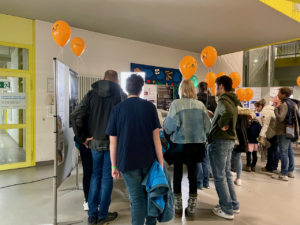
During the Long Night of Science, our scientists explained where colour comes from and how we can take inspiration from nature to make it in the lab, with an info stand and a presentation. We took visitors on a tour of our microscope facilities to show them all the tools and tricks we use to see very tiny things. We also showed how we can use light to study complex systems like whiskey, and played with mathematical combinatorics and optimisation puzzles.
More past events, with reports: Events and appearances.