
Deutsche Version: Diese Seite auf Deutsch
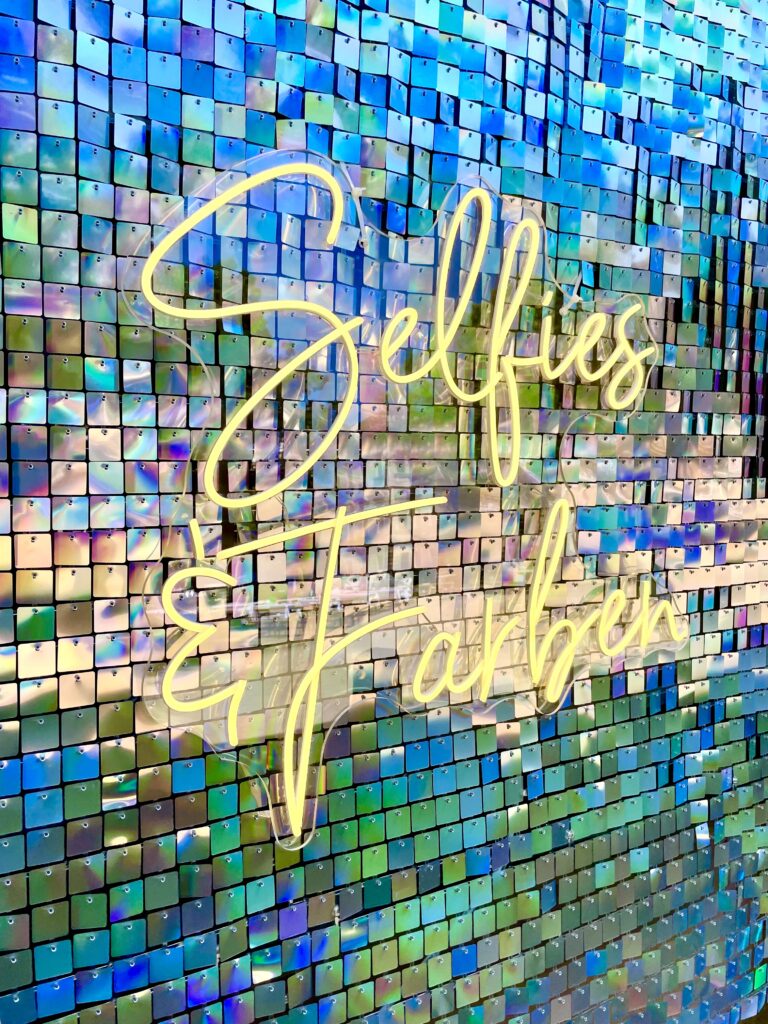
Understanding, experiencing and capturing colour
How does colour arise? Why do colours look different depending on the light? And what happens when we become part of the experiment ourselves?
Selfies & Colours is an interactive photo booth project for the whole family in which curiosity, fun and learning come together naturally.
Your visit to one of our photo booths begins with a short video of about 30 seconds that clearly explains how colour, light and perception are physically connected. What you have learned then becomes directly tangible: different lighting and effects show how colours influence our perception. Finally you take a selfie that is not only a souvenir but also makes the phenomenon explained before visible.
Selfies & Colours combines short explanatory videos, easy-to-understand texts and hands-on trying out into a compact learning experience that requires no prior knowledge. Families discover the physics behind colour together – low-threshold, visual and with a result you can take home and share.
Ideal for museums and exhibitions that want to convey scientific content clearly, in a child-friendly and interactive way. Would you like to use one of our photo booths at your institution? We look forward to hearing from you – get in touch.
All our photo booths
Where does colour come from?
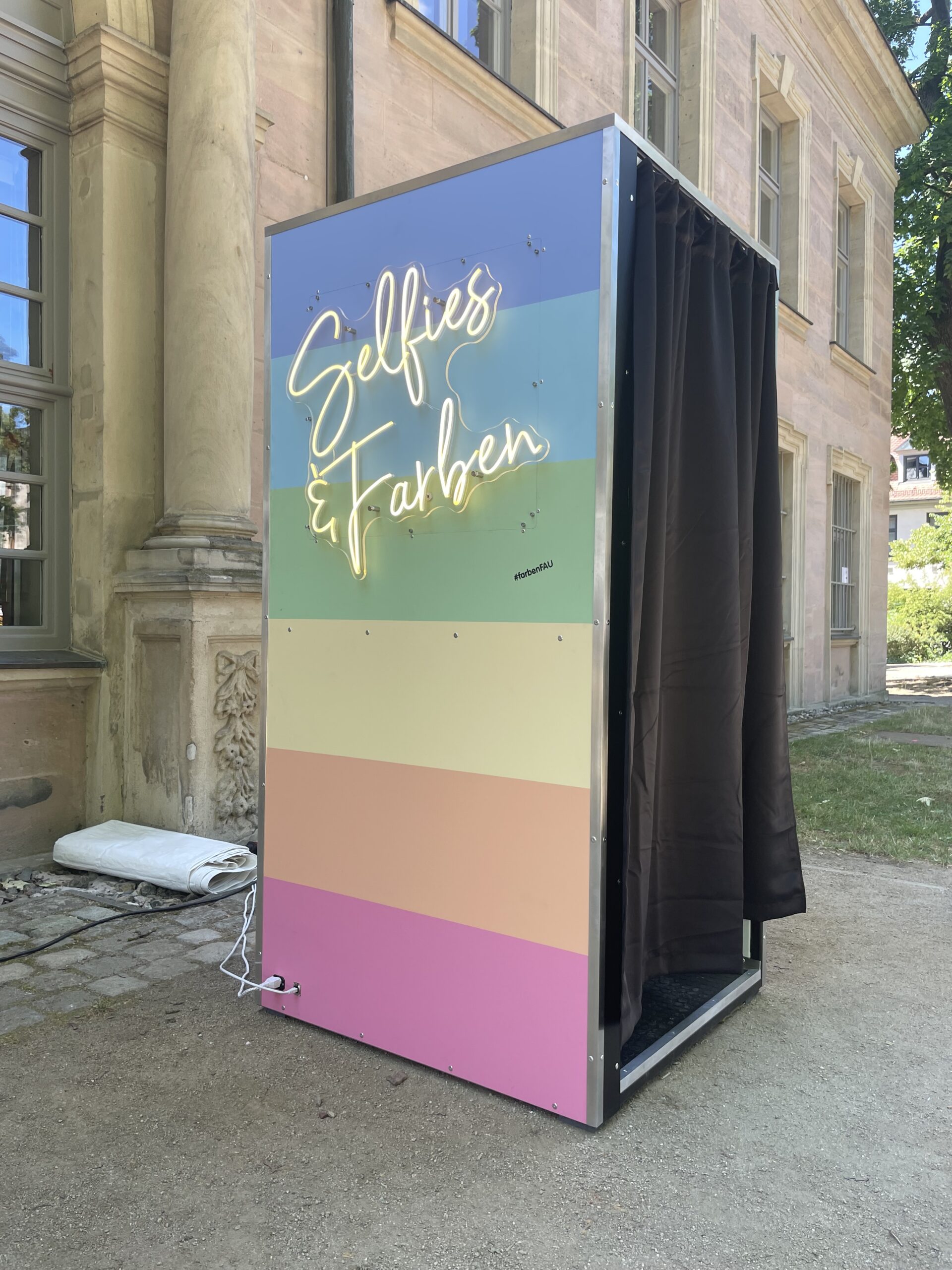
In our rainbow photo booth visitors learn that seemingly white sunlight consists of many different colours. Short explanations show how coloured light overlaps to form white light – and how it can be split back into its individual colours with a prism or even a glass of water.
Inside the photo booth this knowledge becomes directly tangible: three light sources of different colours create coloured shadows behind the visitors. By playing with their hands and bodies, guests discover how colours overlap and change. This creates exciting light effects and unique souvenir photos.
The rainbow photo booth was part of the Schlossgartenfest 2025 and can currently be experienced at the panOPTICUM.
 1/3
1/3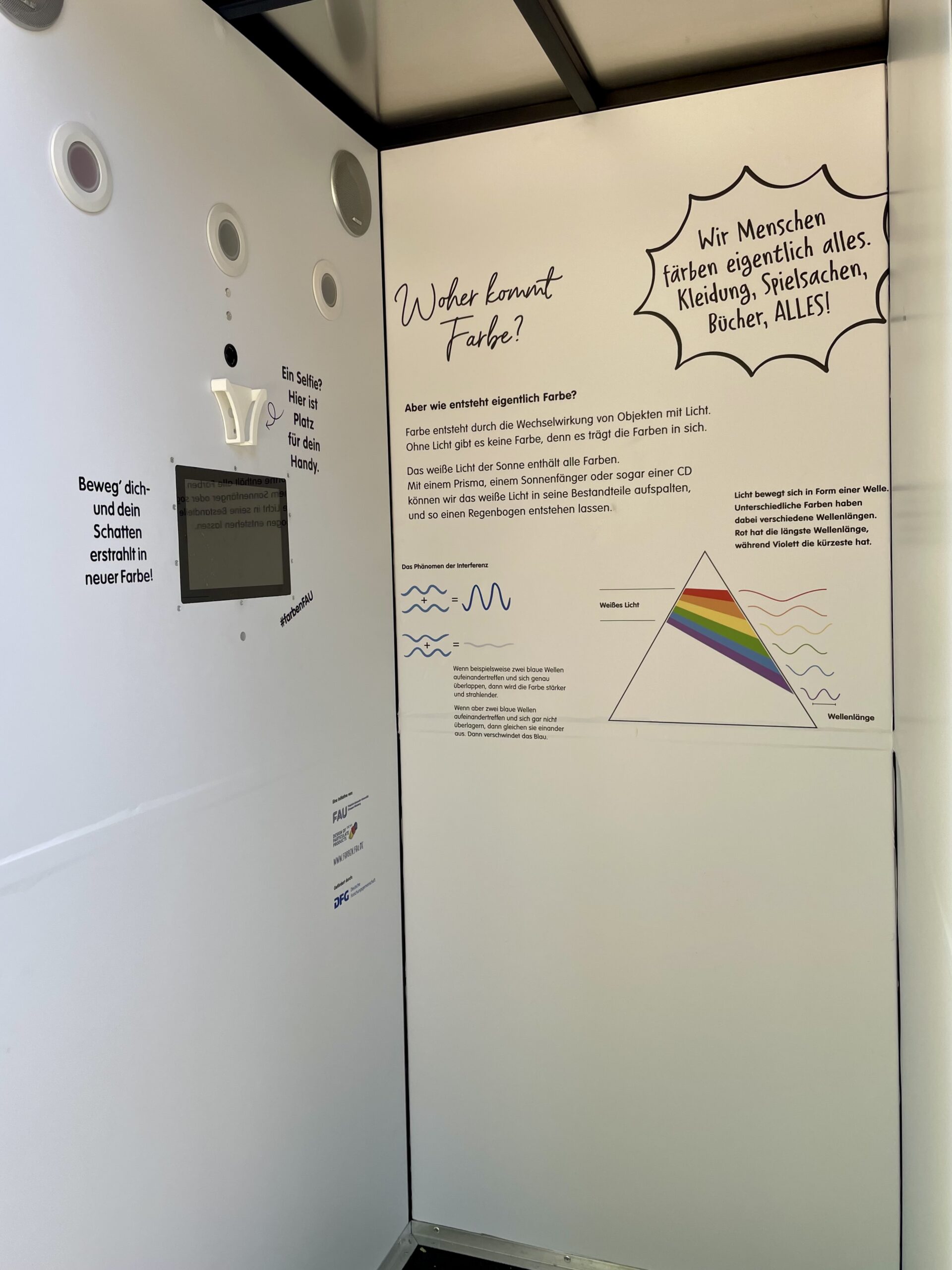 2/3
2/3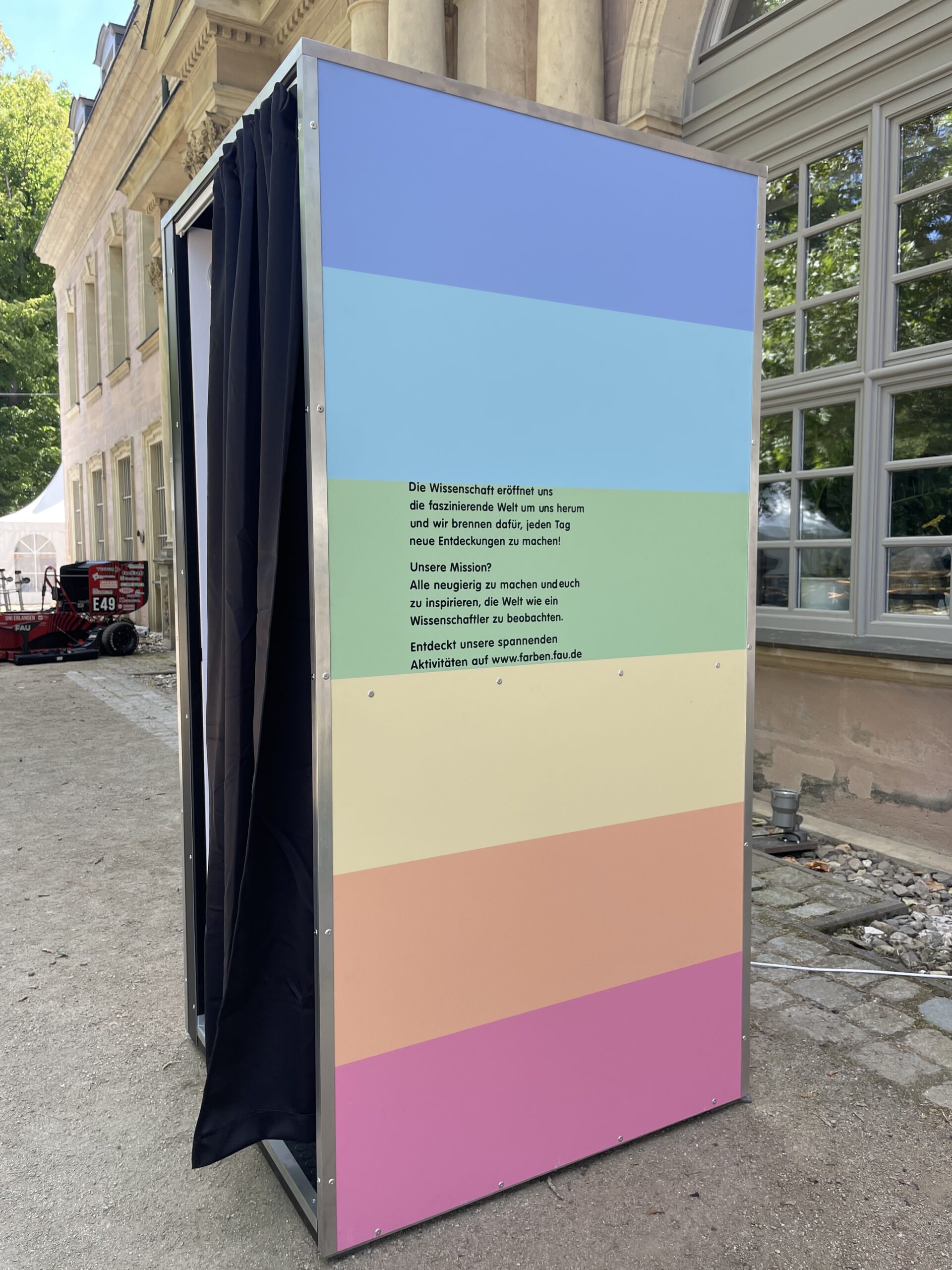 3/3
3/3What are pigments?
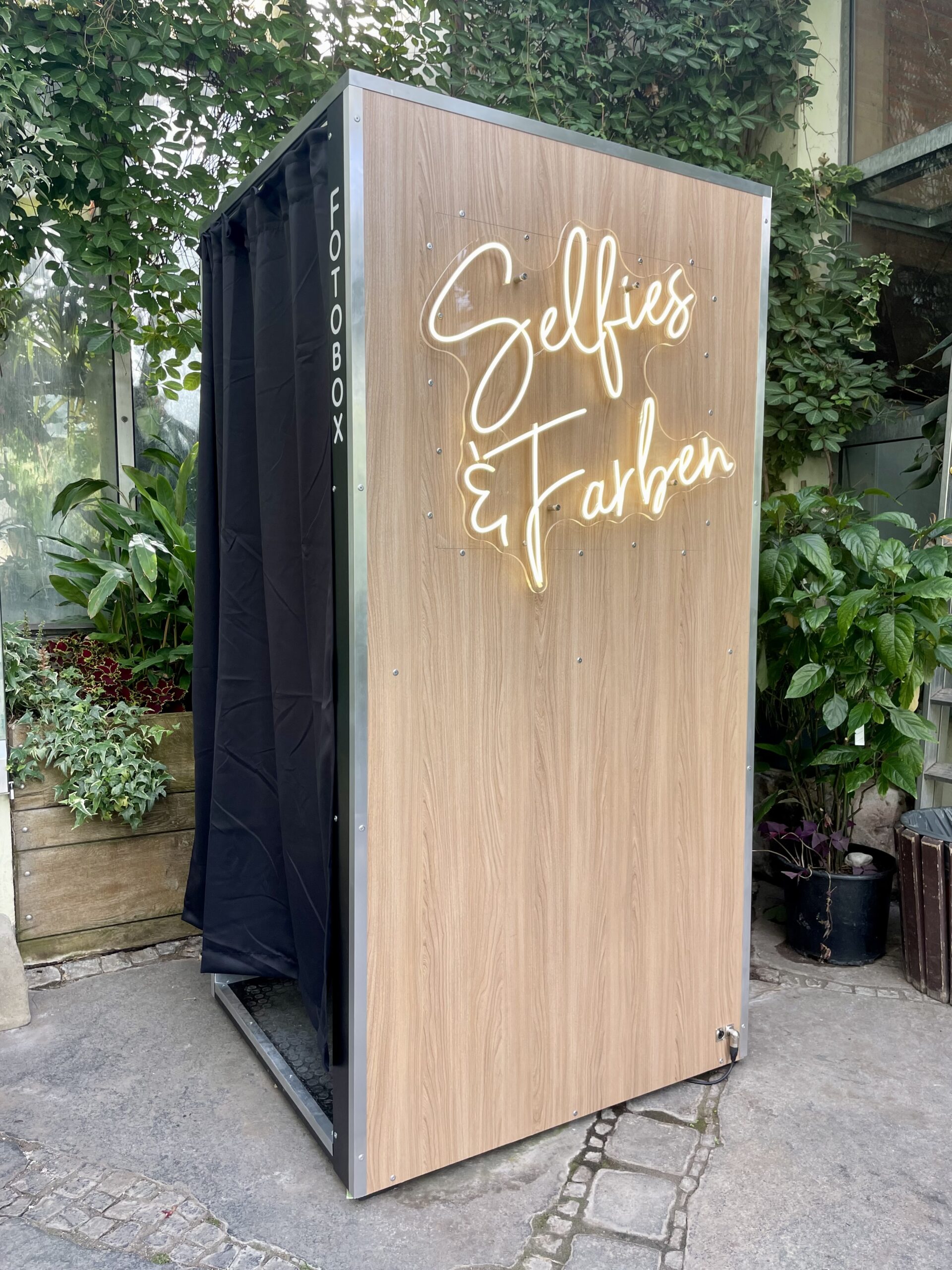 1/32/3
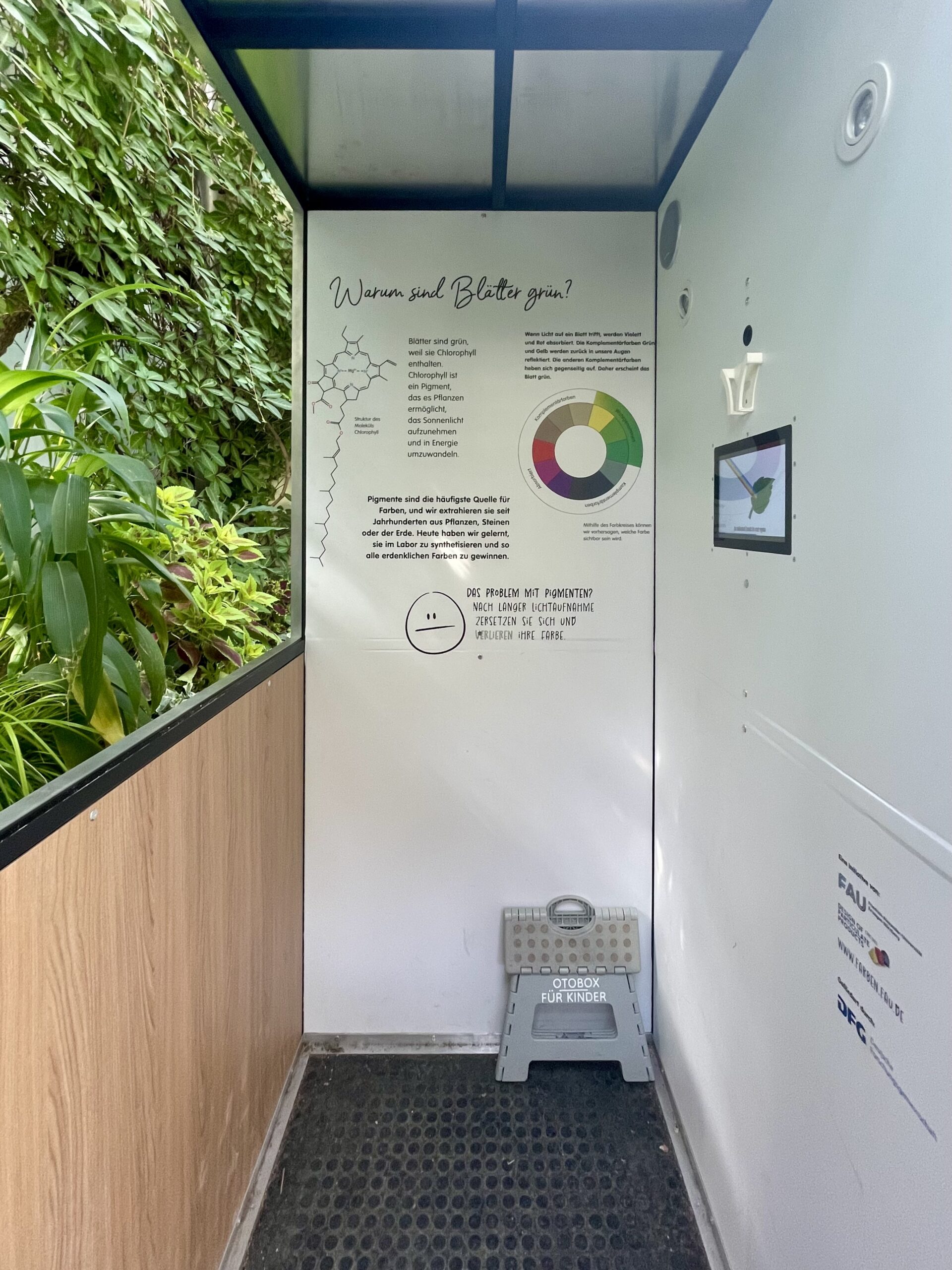 3/3
3/3Look around the botanical garden: leaves, flowers and fruits glow in the most varied colours. But where do these colours actually come from?
Plants owe their colours to tiny dyes – the pigments. Chlorophyll, for example, makes many leaves green. It absorbs part of the sunlight, while we see the green part of the light. Other pigments make flowers appear yellow, orange, red or violet.
The background of the photo booth consists of real plants selected by the Botanical Garden of FAU. In the selfie, guests become part of this special plant world and experience the diversity of plant colours and shapes up close. The botanical collection thus becomes the backdrop and connects the research of CRC 1411 with the fascinating plant world of the Botanical Garden.
The photo booth can be experienced in the Botanical Garden of FAU. In its first month What are pigments? delighted more than 1,000 visitors.
Colour without colourants?
How can butterflies glow an intense blue although their wings contain no blue dyes? The photo booth Colour without colourants shows that colour arises not only from pigments but also from the finest structures that reflect and scatter light in a targeted way.
Short explanations show visitors how so-called structural colours arise and why they are so fascinating and stable in nature. The background of the photo booth consists of high-resolution, real images of butterfly wings and makes the physical principles behind the shimmering blue visible.
In the selfie, visitors become part of this phenomenon themselves and experience how light, structure and viewing angle create colour. The photo booth was part of the special exhibition “Schillernd Schön” at the Bionicum of Tiergarten Nürnberg and combined observation of nature with illustrative physics.
Between April and December 2025, Colour without colourants delighted more than 28,000 visitors.
 1/2
1/2 2/2
2/2Colours that never fade!
 1/1
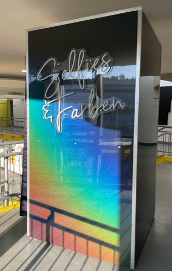
1/1Why do some colours never lose their brilliance? The photo booth Colours that never fade shows how nature creates colour entirely without pigments – and how these strategies can be imitated in research.
Short explanations give insight into how periodic materials made of nanoparticles reflect light in a targeted way, creating so-called structural colours that are permanently stable. Visitors learn how researchers use these principles to develop new materials with special optical properties.
The background of the photo booth consists of transparent, spherical structures that give the impression of being inside a crystal of nanoparticles. In the selfie, guests become part of this nanoscale world and experience how research on interfaces and particles becomes visible.
The photo booth can be experienced at the IPT (Institute of Interfaces and Particle Technology) of FAU and makes current materials research illustrative and accessible.