
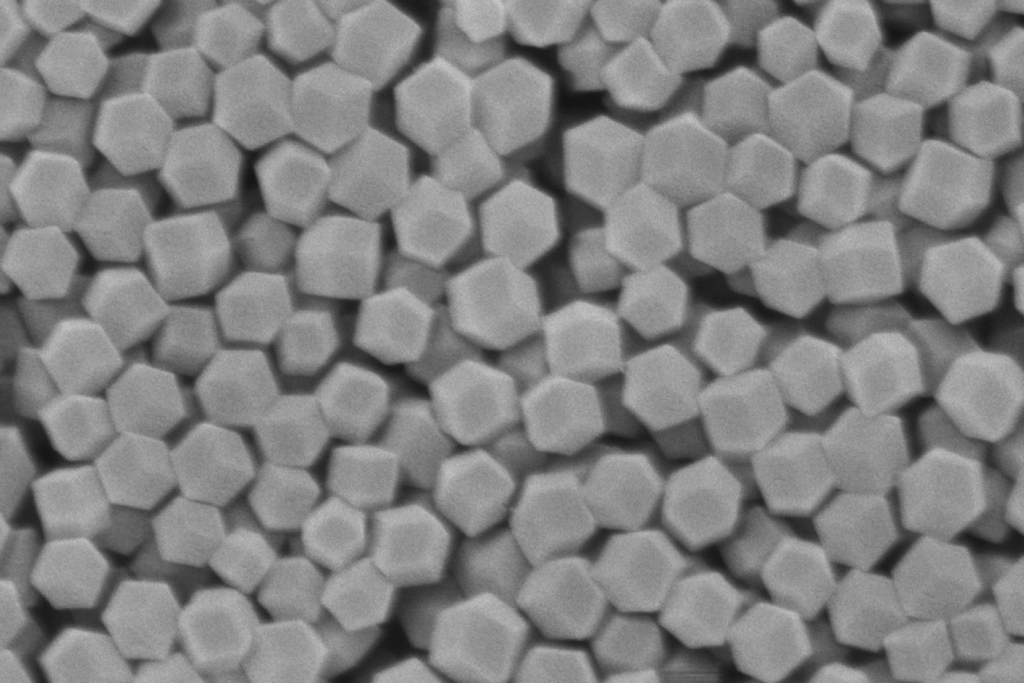
Research Highlight of the Week – 21 September 2026
Metal–organic frameworks are porous crystals whose performance depends strongly on particle size. Producing highly uniform ZIF-8 particles, however, often requires surfactants or other additives that can remain inside the pores and reduce adsorption capacity. An international team with strong CRC 1411 connections have now shown that particle size can instead be controlled physically through the way the liquids are mixed. The additive-free method produces monodisperse ZIF-8 particles while preserving their accessible pore volume.

In simple words …ZIF-8 is a crystal full of holes so tiny that molecules can fit inside. Scientists want to make many ZIF-8 particles that are almost exactly the same size, because uniform particles can pack into neat structures and work more reliably. Usually, chemicals are added to control particle growth, but some can stay inside the tiny pores. The researchers found another way: control how strongly the liquids are mixed. At the very beginning, extremely small crystal pieces form. Stronger mixing makes more of them collide and join together, leaving fewer particles that then grow larger. Gentler mixing gives smaller particles. Because the finished particles are so uniform, they can arrange themselves into ordered patterns that create colour without dyes. When methanol vapour enters the pores, that colour changes. So a simple change in fluid flow can control both the size of microscopic crystals and the behaviour of the materials built from them.
What the team found
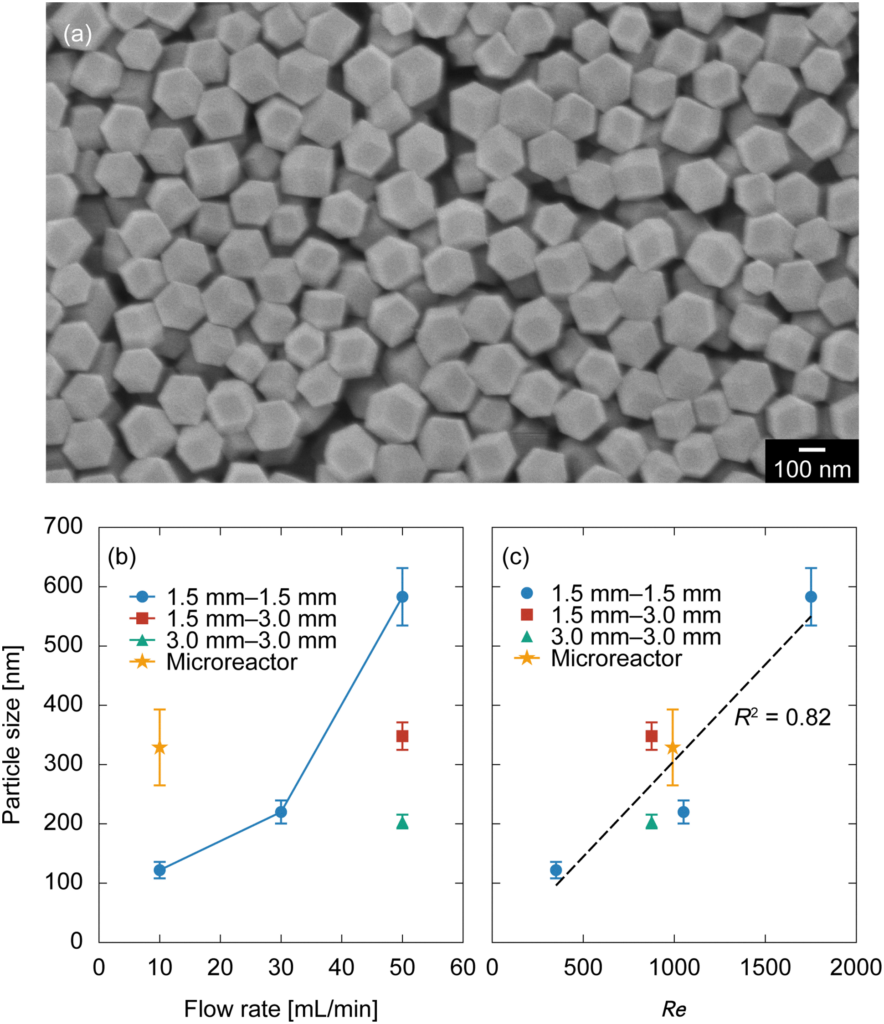
The researchers from Kyoto University and Shinshu University in Japan, Eastern Institute of Technology in China, and FAU Erlangen-Nürnberg synthesised ZIF-8 in a water/methanol mixture and found that stronger stirring or faster flow produced larger particles without substantially broadening the size distribution. The explanation lies in the first moments of crystallisation: very small nuclei can collide and merge, and stronger fluid shear increases these early coalescence events. Once the particles become larger, electrostatic repulsion suppresses further aggregation, so they continue growing individually. The same principle was transferred from stirred batches to continuous flow using simple T-shaped mixers. Across different mixer geometries, particle size correlated with the Reynolds number, providing a practical engineering parameter for tuning the synthesis.


Why this CRC 1411 collaboration matters—and where it leads
The CRC 1411 connection. The study connects fluid dynamics, particle-formation mechanisms and colloidal self-assembly. By identifying mixing intensity as a physical design parameter, it supports CRC 1411’s aim of replacing empirical recipes with process–structure relationships that can be used predictively. The collaboration combines flow-synthesis expertise at Kyoto University with CRC 1411 research on monodisperse particles and their assembly into ordered functional materials.
Looking ahead. The next step is to test whether the same mechanism applies to other metal–organic frameworks. If transferable, flow-based design rules could help engineers choose mixer geometry and operating conditions for a desired particle size, supporting continuous and scalable production of porous particles for adsorption, separation and sensing.
CRC 1411 researchers among the co-authors: Nicolas Vogel, CRC 1411 Coordinator and Principal Investigator; Satoshi Watanabe, CRC 1411 Mercator Fellow
A. Fujiwara, S. Hiraide, J. Wang, S. Danjo, N. Vogel and S. Watanabe, “Additive-free size tuning of monodisperse ZIF-8 particles via fluidic control for advanced colloidal architectures,” Chemical Communications 62(66), 16455–16458 (2026). DOI: 10.1039/D6CC04499