
Research Highlight of the Week – 5 October 2026
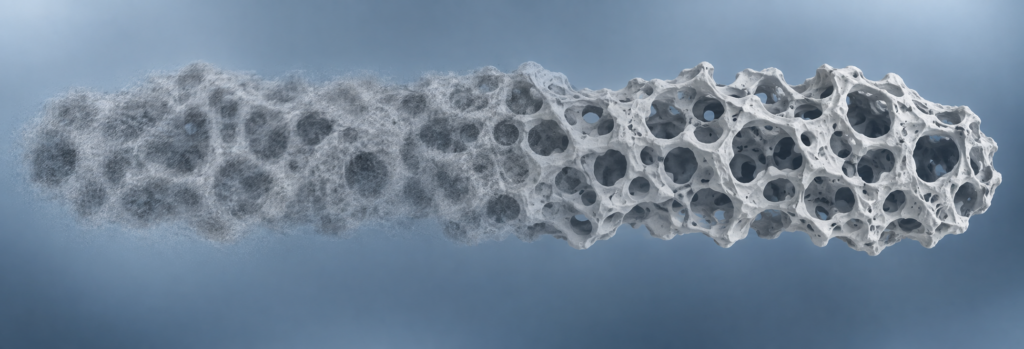
Nano- and microtomography reconstruct three-dimensional structures from many flat projections. Limited angles and noisy measurements can blur boundaries between materials. CRC 1411 researchers developed a hybrid reconstruction method that combines a neural network’s ability to identify likely edges with mathematical optimization that checks those suggestions against the measurements. In tests on simulated and experimental data, the resulting images had sharper interfaces and more uniform material regions than benchmark reconstructions.

In simple words …Tomography builds a three-dimensional picture from many flat views taken around an object. Hospitals use the same idea in CT scans; materials researchers use X-rays or electrons to look inside tiny structures. When there are too few views or the measurements are noisy, the picture can look blurred and distorted. This team used two helpers. A neural network learned to suggest where a clear border between materials might be. Mathematical optimization then checked those suggestions against the original measurements and could reject an AI guess that did not fit. In tests on porous particles and a tiny copper lattice, the method made boundaries sharper and solid regions more even. Clearer 3D maps can help researchers measure pores and defects more reliably.
What the team found
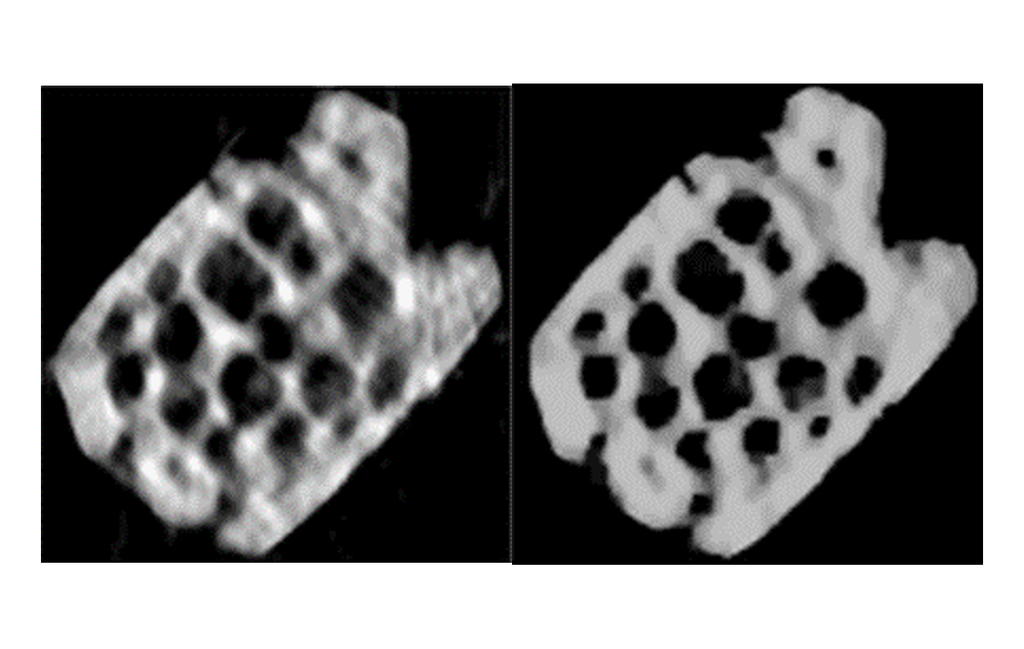
The researchers trained a neural network to recognise local patterns associated with sharp boundaries. They then embedded its edge predictions in a mixed-integer optimization model for tomographic reconstruction. The learned information favours clean boundaries and homogeneous material regions, but it does not dictate the answer: the optimization can choose another reconstruction when the projection data support it more strongly. This is useful for samples with distinct material phases, where conventional methods can leave blurred interfaces or patchy regions. The team tested the approach on simulated images and experimental electron-tomography and nano-CT data, including porous zeolite particles and a copper microlattice. Compared with benchmark methods, the hybrid approach improved interface sharpness and phase homogeneity. The work demonstrates how learned image features can be combined with explicit mathematical constraints, while keeping the measured projections central to the reconstruction.
The present demonstrations focus on specimens with relatively homogeneous phases and sharp edges. Larger volumes, additional phases and uncertainty estimates remain important challenges.
 2/2
2/2The CRC 1411 connection and next steps
The CRC 1411 connection. The study connects materials imaging with machine learning and mathematical optimization. Microscopy provides difficult, incomplete measurements; the neural network suggests local structure; and the optimization model checks the complete reconstruction against those data. This combination supports CRC 1411’s goal of linking particle structure to product properties. More dependable three-dimensional maps are needed to quantify pores, interfaces and defects and to test whether synthesis and structure models describe real particulate materials accurately.
Looking ahead. A logical next step is to test larger images, more than two material phases and a wider range of specimens. Estimates of reconstruction uncertainty would help researchers identify where additional projections are worth collecting and where the current image is already reliable.
CRC 1411 co-authors of the study
Doctoral researchers: Andrea Gilch
Postdoctoral researchers: Jan Rolfes
Principal investigators: Benjamin Apeleo Zubiri, Frauke Liers
CRC projects involved
A. Mishra, A. Gilch, B. Apeleo Zubiri, J. Rolfes and F. Liers, “High-Quality Tomographic Image Reconstruction Integrating Neural Networks and Mathematical Optimization,” Machine Learning: Science and Technology 6(4), 045065 (2025). DOI: 10.1088/2632-2153/ae25b6.