

Research Highlight of the Week – 28 September 2026
Chemical separations often rely on differences in size or chemical affinity. CRC 1411 researchers have shown that molecular shape can matter when choosing how to separate related carbon compounds. They compared nearly spherical C60 with flat, disk-shaped coronene in a silica chromatography column. Experiments and molecular simulations traced their different travel times to thin, organised solvent layers at the silica surface. The result points toward separations designed around shape as well as composition.
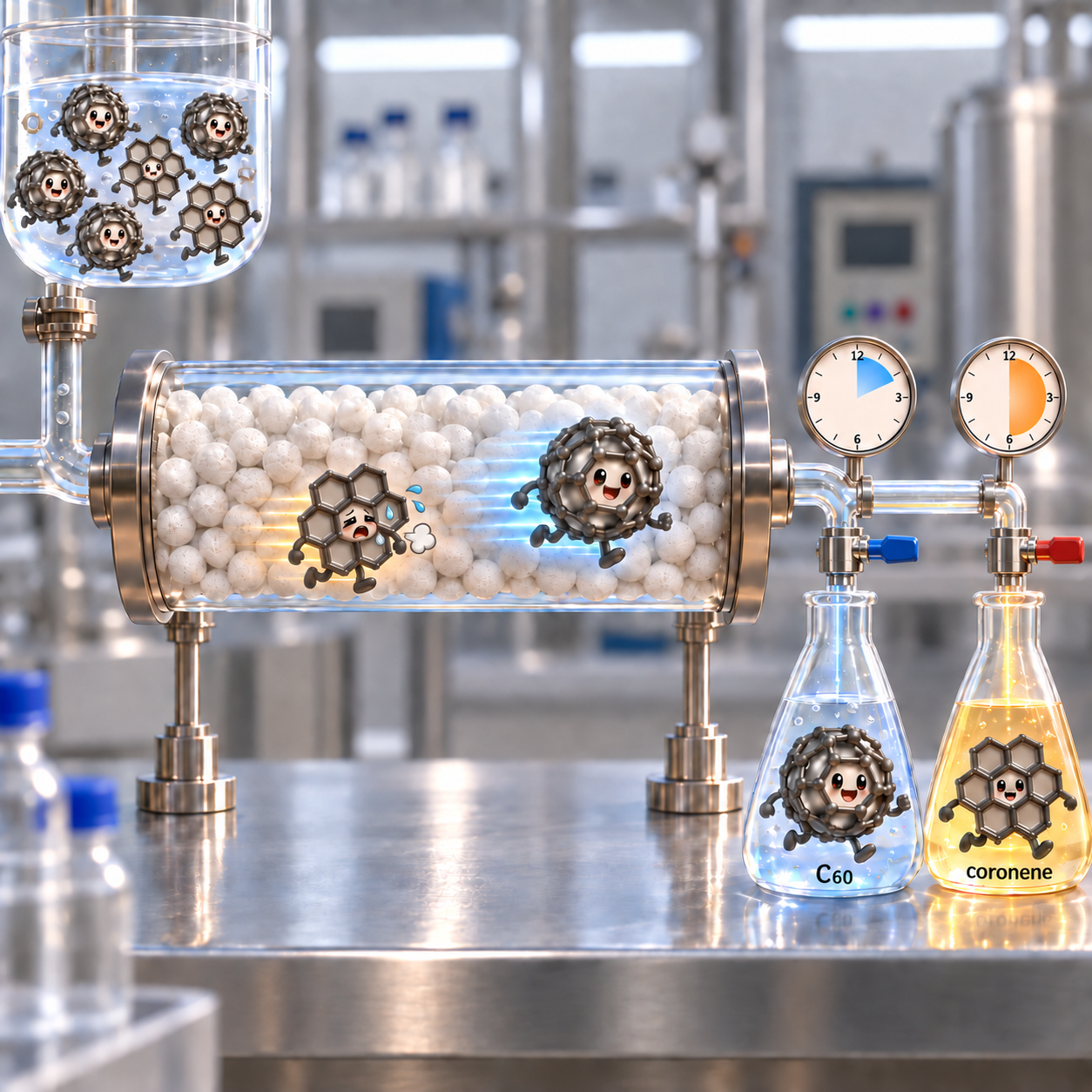
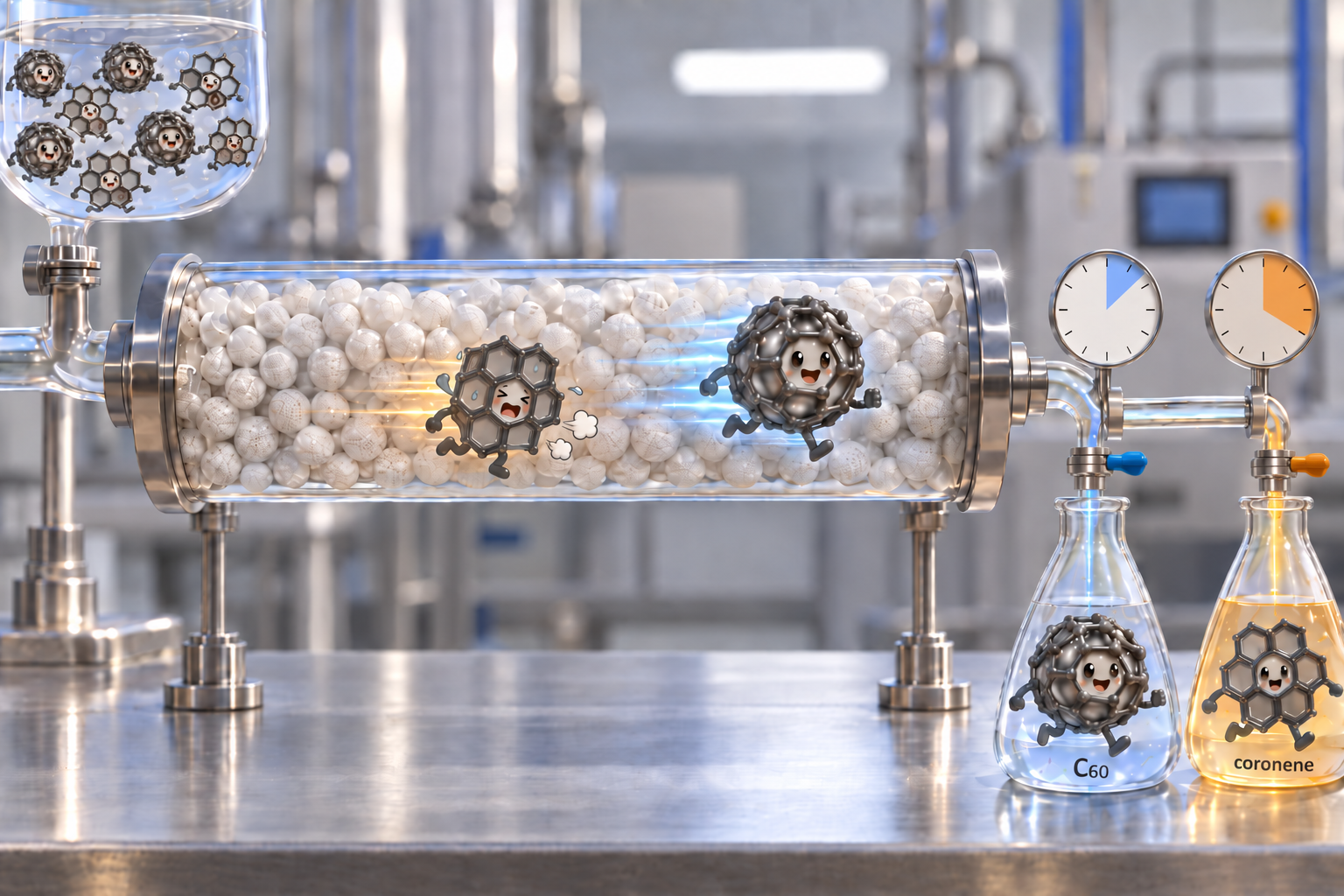
In simple words …Chromatography separates a mixture by carrying it in a liquid through a tube filled with small solid grains. Some ingredients stick to the grains for longer, so they come out later. In this study, the researchers compared two carbon molecules: C60 is roughly ball shaped, while coronene is flat like a coin. Both met very thin layers of liquid next to the silica grains. The flat molecule interacted with those layers differently and was held longer than the ball. By changing the mix of two liquids, the researchers made that difference stronger. Their experiments and computer simulations explain how the liquid near a surface can help recognise shape. The idea could eventually help scientists separate substances that have similar chemistry but different forms.
What the team found
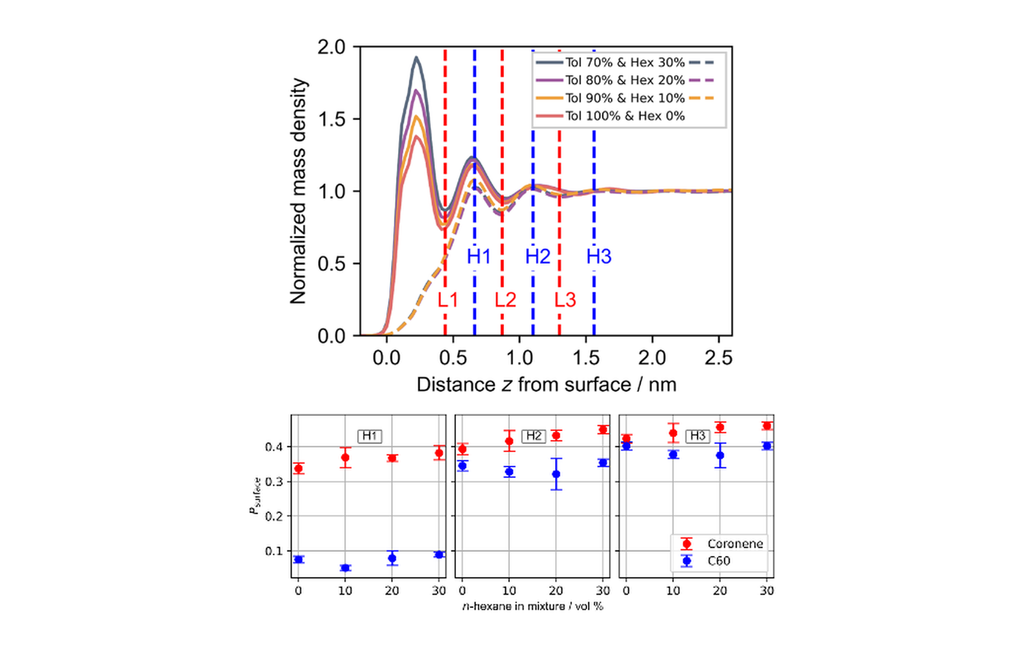
The team passed C60 and coronene through a hydroxylated-silica column using mixtures of toluene and n-hexane. Increasing the proportion of n-hexane improved the separation because the flat coronene molecules stayed in the column longer than the nearly spherical C60 molecules. To explain this result, the researchers simulated the liquid and both molecules close to the silica surface and analysed adsorption with a two-state model. Toluene forms a structured first layer at the surface; the composition and organisation of the next layer influence how each molecule can approach and bind. The second layer proved particularly important for the measured retention. This links a molecular-scale arrangement of solvent to the different times at which the two substances emerge from the column. It also shows how changing the mobile liquid, without changing the solid packing, can strengthen a separation based on molecular shape. The study used two deliberately simple model compounds. Whether the same rule works for more complex mixtures or other surfaces remains a question for further experiments.
 2/2
2/2The CRC 1411 connection and next steps
The CRC 1411 connection. The CRC 1411 team combined chromatography experiments, molecular simulation and a physical model of adsorption. While the experiments revealed which molecule was retained, the simulations showed how toluene organised itself at the silica interface. Finally, the model connected that arrangement to the measured separation. This is a concrete example of CRC 1411’s predictive design approach: use a molecular mechanism to choose a process condition, here the mobile-phase composition, that produces a desired separation. The work joins expertise in separation technology and interfacial physics.
Looking ahead. The next test is whether the solvent-layer mechanism also predicts retention for other molecular shapes, surface chemistries and more complicated mixtures. If it does, it could reduce trial-and-error screening when selecting a liquid and stationary phase for a target separation.
CRC 1411 co-authors of the study
Doctoral researchers: Rustam Durdyyev, Jan-Christoph Domagala
Postdoctoral researchers: Malvina Supper
Principal investigators: Malte Kaspereit, Ana-Sunčana Smith
CRC projects involved
R. Durdyyev, M. Supper, J.-C. Domagala, G. Hantal, M. Kaspereit and A.-S. Smith, “Shape-Selective Separation of Model Analytes in Normal-Phase Liquid Chromatography: A Combined Simulation-Experimental Study,” Analytical Chemistry 97(24), 12786–12794 (2025). DOI: 10.1021/acs.analchem.5c01710