

Research Highlight of the Week – 19 October 2026
Nanoparticle synthesis can result in a mixture of sizes, aggregates and dissolved impurities. Hence, downstream processing is essential in order to purify the product. Researchers from five CRC 1411 projects have joined forces to produce and characterize porous silica spheres called supraparticles. They then used these spheres as a column packing for size-exclusion chromatography, which separates nanoparticles, aggregates and impurities according to how much of the pore network they can enter.
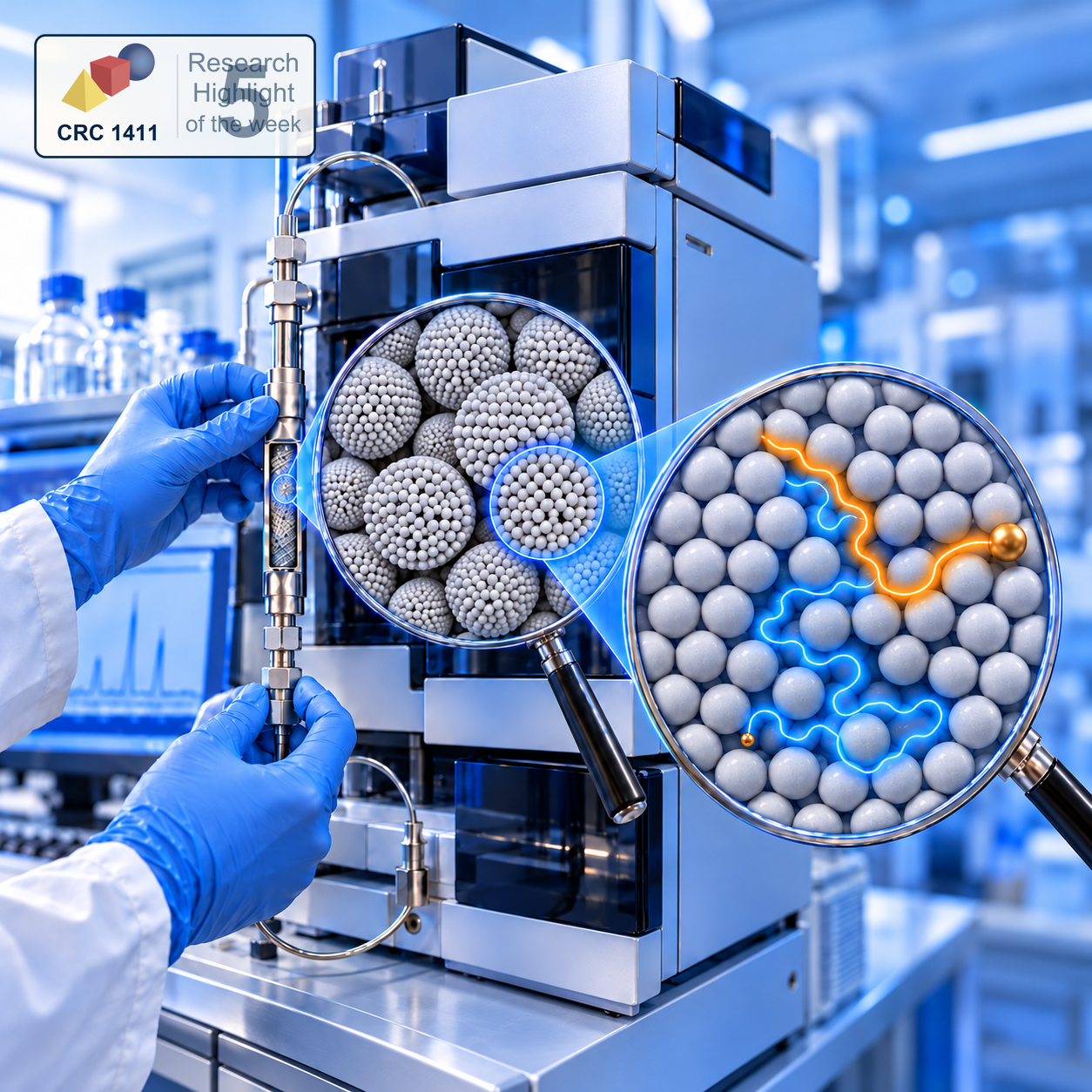
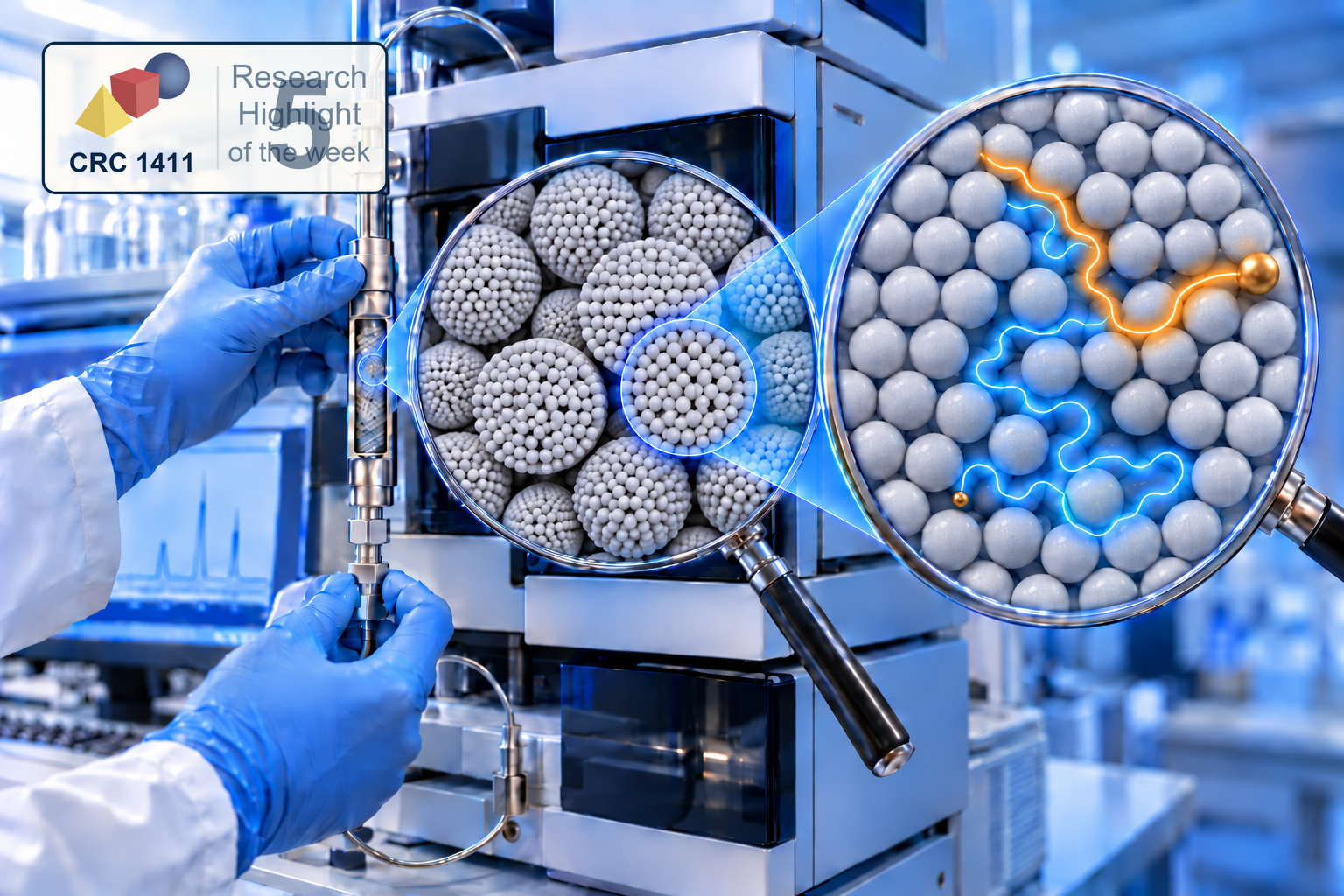
In simple words …A nanoparticle is a tiny piece of material, hundreds to thousands of times smaller than the width of human hair. Methods to produce them often result in many different sizes, as well as clumps. These need to be sorted out to obtain particles with the desired properties, such as the colour. Chromatography does this by carrying the mixture in a liquid through a packed column. In this study, the column was filled with porous balls called supraparticles, each made from many smaller glass spheres. Imagine each supraparticle as a building with narrow corridors. Small nanoparticles can enter more of the corridors and spend longer inside. Larger ones cannot fit through as many openings, so they leave the column sooner. The researchers adjusted the pore size to control this difference and also found a way to strengthen the supraparticles to withstand the high pressure used to pack the column.
What the team found
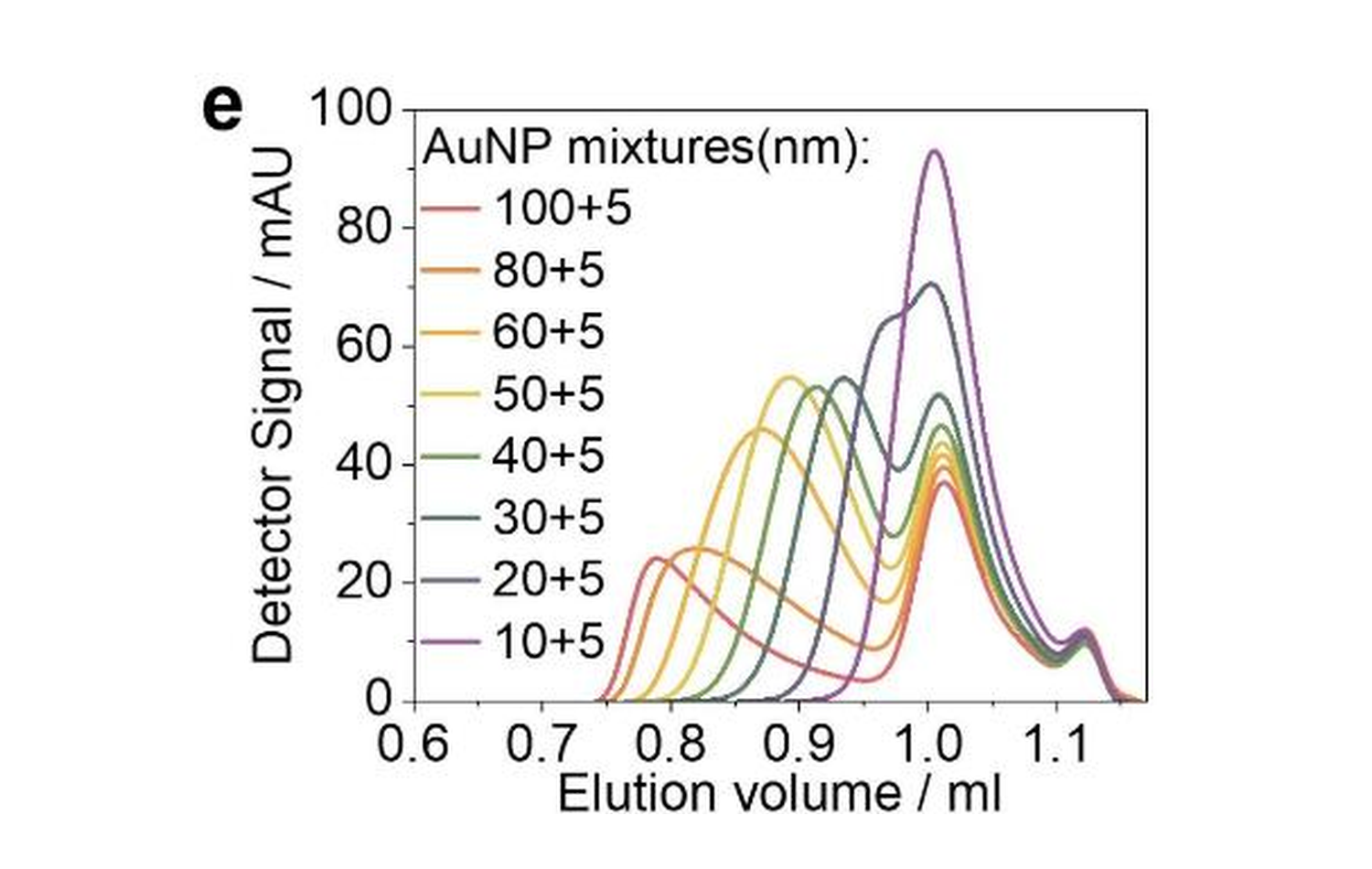
The team produced assembled silica nanoparticles into 13–25 µm diameter spherical aggregates. These so-called supraparticles had pore sizes averaging about 70–200 nm. Heat treatment strengthened the supraparticles enough to withstand column packing, while adding a binder increased their strength further. Tests with gold nanoparticles 5–100 nm in diameter, whose size-dependent optical properties reflect localized surface plasmon resonances (collective electron oscillations driven by light), showed the expected size-exclusion behaviour: smaller nanoparticles entered more of the pores and left the column later; larger ones accessed less of the pore network and left sooner. Changing the size of the silica building blocks altered the pore size and, in turn, which nanoparticles could enter.
The columns separated nanoparticles from dissolved impurities and agglomerates of particles. Mixtures containing two nanoparticle sizes were separated partly or almost completely, depending on the size difference. X-ray micro-computed tomography provided three-dimensional images of the packed columns. These revealed gaps and uneven packing that helped explain why the separated fractions spread out instead of emerging as sharply defined peaks.
Particles of very similar sizes were harder to separate. More uniform column packing is therefore an important next step, alongside choosing pores suited to the target mixture.
CRC 1411 connection and next steps
The CRC 1411 connection. The collaboration combined particle synthesis and self-assembly, pore design, mechanical testing, chromatography and three-dimensional imaging. Together, these methods traced how the structure and strength of individual supraparticles, and their arrangement inside a column, affect separation. This fits CRC 1411’s aim of designing particulate products by understanding the links between how they are made, how they are structured and how they perform.
Looking ahead. More uniform packing could improve the separation of particles with similar sizes. Testing more complex mixtures would help establish how broadly the approach can be used.
CRC 1411 co-authors of the study
Doctoral researchers: Umair Sultan, Lukas Hartmann, Céline Kohl, Allison Götz
Principal investigators: Erdmann Spiecker, Martin Hartmann, Wolfgang Peukert, Benjamin Apeleo Zubiri, Malte Kaspereit, Nicolas Vogel
CRC projects involved
U. Sultan, L. Hartmann, C. Kohl, A. Götz, A. Krapf, R. Ditscherlein, E. Löwer, B. Merle, U. A. Peuker, E. Spiecker, M. Hartmann, W. Peukert, B. Apeleo Zubiri, M. Kaspereit and N. Vogel, ‘Supraparticle powders as stationary phase materials for size-exclusion chromatography of nanoparticles,’ Journal of Colloid and Interface Science 714, 140141 (2026). DOI: 10.1016/j.jcis.2026.140141.